Introduction
Every hospital lab generates a constant stream of samples, test orders, and results — and a single misplaced report or delayed result can directly affect patient care. A Laboratory Information System (LIS) is built to solve exactly this problem. As more Indian hospitals digitize their operations with HMS and EHR systems, the laboratory is often the last department still running on registers and manual report typing.
What Is a Laboratory Information System (LIS)?
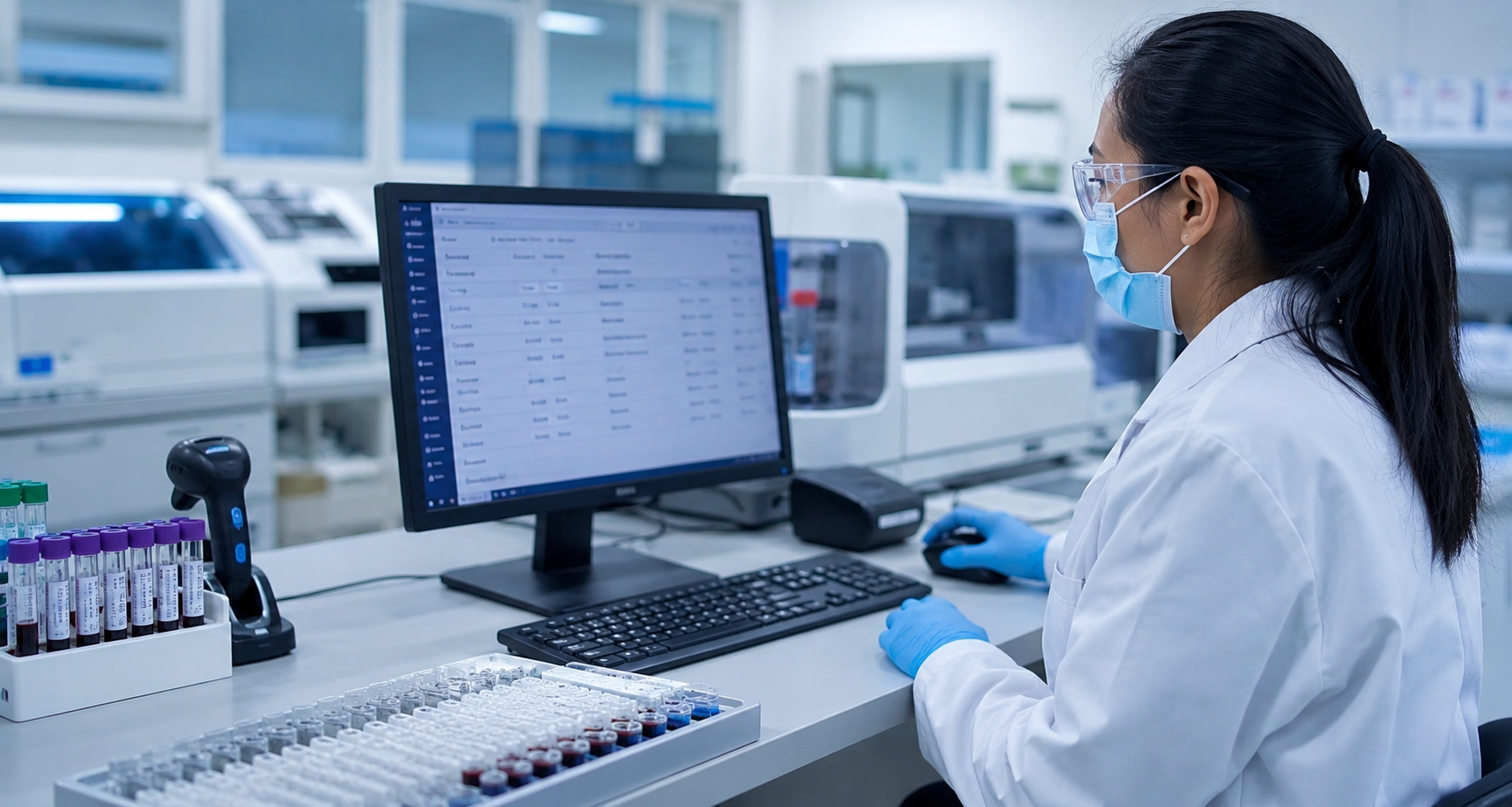
A Laboratory Information System is software designed specifically to manage the workflow of a hospital or diagnostic laboratory — from the moment a sample is collected to the moment a report reaches the doctor or patient. It tracks test orders, manages sample status, automates result entry from lab instruments, and generates reports, while keeping every step logged and traceable.
How an LIS Fits Into a Hospital's Wider Systems
A Hospital Management System runs the hospital's overall operations — registration, billing, scheduling. An Electronic Health Record holds the patient's complete medical history. The LIS is the specialised layer focused entirely on laboratory workflow — and ideally connected to both, so a doctor ordering a blood test through the HMS sees the result appear directly in the patient's EHR once the lab processes it.
Core Functions of an LIS
1. Sample Tracking
Every sample is logged with a unique ID the moment it's collected, and its status — collected, in-process, completed — is visible in real time, eliminating the guesswork of physically locating a sample.
2. Test Order Management
Doctors can place lab orders digitally, which route directly to the right testing department, removing the need for paper requisition slips that can be lost or misread.
3. Instrument Integration
Modern LIS platforms connect directly to lab analysers and machines, pulling results automatically instead of requiring a technician to manually retype values — a major source of transcription errors in manual labs.
4. Automated Report Generation
Once results are verified, the system generates a formatted report automatically and routes it to the doctor, the patient portal, or both.
5. Quality Control and Audit Trails
Every action — who entered a result, when, and any changes made — is logged, which is essential both for catching errors and for regulatory compliance.
Manual Lab Processes vs. LIS
| Manual Lab Process | With an LIS |
|---|---|
| Paper requisition slips, easily lost | Digital orders routed automatically |
| Manual result entry from machines | Automated instrument integration |
| Reports typed and compiled by hand | Reports generated and shared automatically |
| Sample location tracked verbally or on paper | Real-time digital sample tracking |
| Errors caught late, if at all | Built-in quality checks and audit trails |
| Disconnected from HMS/EHR | Integrated with hospital-wide patient records |
Why Hospitals Need an LIS
- Fewer transcription errors from automating manual data entry handoffs
- Faster turnaround times — patients and doctors get reports sooner
- Better coordination with doctors via direct HMS/EHR integration
- Easier compliance for NABL and other accreditation standards
- Scalability as test volume grows without proportional admin staff increases
How MedXL Helps Hospitals
At MedXL, our LIS is built to solve the exact problems above. Here's what it does for your lab day to day:
- Logs every sample with a unique ID at collection for real-time status visibility
- Routes test orders digitally from ward or OPD straight to the right lab section
- Connects directly to your lab analysers, pulling results automatically
- Generates and shares formatted reports the moment results are verified
- Integrates with our HMS and EHR so doctors see results in the patient's record instantly
- Keeps a full audit trail of every entry and change for NABL compliance
- Tracks reagent and supply stock, flagging shortages before they delay testing
Frequently Asked Questions
Conclusion
The laboratory is often the busiest, most error-sensitive department in a hospital — and frequently the last one to move beyond paper. A Laboratory Information System closes that gap, reducing errors, speeding up turnaround times, and connecting the lab to the rest of the hospital's digital systems.