Introduction
Hospitals today face a clear choice: continue relying on manual, paper-based processes, or move to a digital Hospital Management System (HMS). The decision affects everything from patient wait times to billing accuracy and staff workload. In this article, we compare manual hospital management with HMS-based operations to help you understand which approach truly serves your hospital — and your patients — better.
What Is Manual Hospital Management?
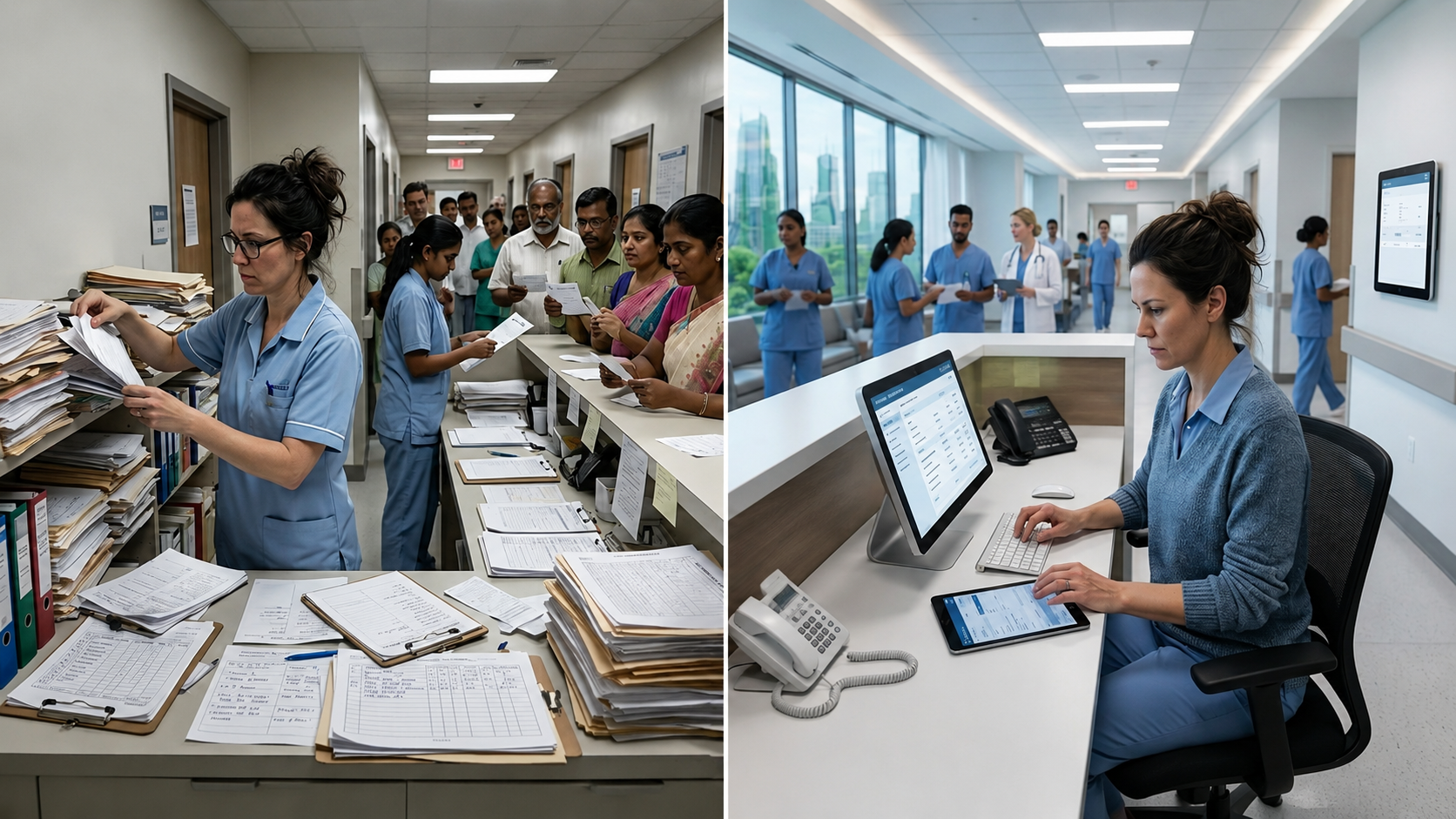
Manual hospital management refers to running day-to-day hospital operations — patient registration, appointment scheduling, billing, record-keeping, and inventory — using paper records, registers, and disconnected spreadsheets instead of integrated software. Many small and mid-sized hospitals in India still depend heavily on these manual processes, often because of familiarity, lower upfront cost, or simply not having explored digital alternatives.
What Is a Hospital Management System (HMS)?
A Hospital Management System is integrated software that digitizes and connects every department of a hospital — from the front desk to the pharmacy, laboratory, billing counter, and administration office — into a single platform. It replaces paper trails with real-time digital records that any authorized staff member can access instantly.
The Cost of Staying Manual, by the Numbers
The gap between manual and digital hospital operations isn’t just anecdotal. Industry research on manual record-keeping workflows has found that paper-based processes can run as much as 50% less productive than equivalent digital workflows — time that, in a hospital, translates directly into longer queues and slower discharge. Globally, medication errors linked to manual prescribing and documentation are estimated to affect millions of patients and cost healthcare systems billions of dollars a year, a risk that automated, cross-checked digital systems are specifically designed to reduce. India’s own hospital management software market — projected to roughly double from $12.4 billion in 2025 to $25.7 billion by 2031 — reflects how quickly hospitals nationwide are making this same call.
HMS vs Manual Management: Key Differences
| Aspect | Manual Management | Hospital Management System |
|---|---|---|
| Patient Registration | Paper forms, repeated each visit | One-time digital record, reused automatically |
| Record Access | Physical files, prone to loss or delay | Instant digital access from any department |
| Appointment Scheduling | Phone calls and registers | Automated online booking and reminders |
| Billing | Manual calculation, higher error risk | Automated, accurate, and faster |
| Reporting | Compiled manually, often delayed | Real-time dashboards and analytics |
| Data Security | Vulnerable to physical damage or loss | Encrypted, access-controlled, and backed up |
Why Hospitals Are Moving From Manual to HMS
1. Fewer Errors, More Accuracy
Manual data entry is prone to human error in billing, prescriptions, and patient records. An HMS automates calculations and cross-checks data, significantly reducing mistakes.
2. Faster Patient Service
Digital registration and instant record retrieval cut waiting times dramatically compared to searching through paper files.
3. Better Coordination Across Departments
An HMS connects the front desk, lab, pharmacy, and billing in real time, eliminating the communication gaps that are common in manual setups.
4. Easier Compliance and Audits
Digital records are easier to organize, retrieve, and present during regulatory audits than paper files scattered across departments.
5. Scalability
As patient volume grows, manual processes become harder to manage, while an HMS scales without adding proportional administrative staff.
In Practice: A Hospital’s Shift From Registers to Real-Time Records
Consider a 40-bed hospital that, for years, tracked patient registration in handwritten registers and calculated bills by hand at the counter. Finding a returning patient’s file meant a clerk searching through physical folders, and any billing error meant either an awkward conversation with the patient or an unrecovered cost absorbed by the hospital. After moving to an HMS, registration became a one-time digital entry that auto-filled on every future visit, and billing calculated itself from the treatment record instead of a calculator and a ledger. Reports that used to take a day to compile manually were available in real time.
How MedXL Helps Hospitals
At MedXL, we help hospitals move away from manual, error-prone processes with healthcare technology built specifically for Indian hospitals. Our solutions include:
- Hospital Management System (HMS)
- Electronic Health Records (EHR)
- Laboratory Information System (LIS)
- Online Appointment Booking
- Professional Hospital Websites
- Healthcare Digital Transformation Services
Our goal is to help hospitals embrace technology while focusing on what matters most — delivering exceptional patient care.
Frequently Asked Questions
Conclusion
While manual hospital management may feel familiar, it increasingly holds hospitals back as patient volumes grow and expectations rise. A Hospital Management System isn’t just a convenience — it’s becoming a necessity for hospitals that want to operate efficiently, reduce errors, and deliver better patient care.